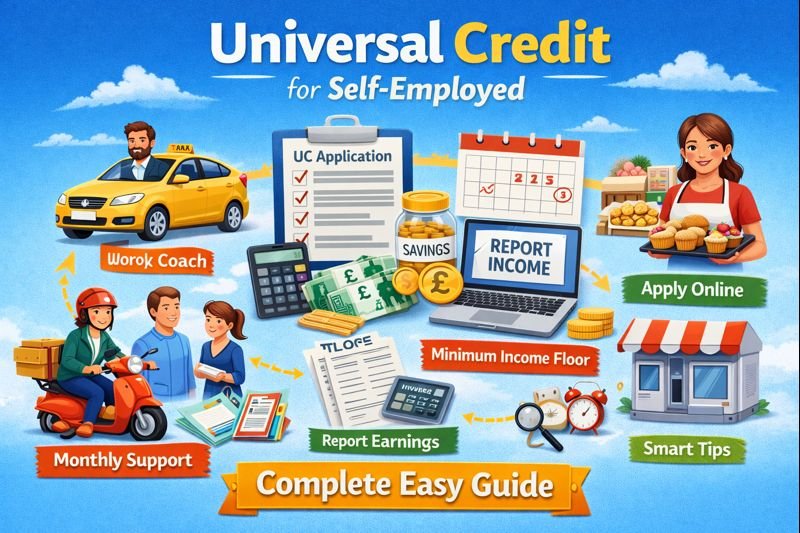
Universal Credit for Self-Employed – Complete Easy Guide
Published: 20 Jan 2026
Introduction
Life as a self-employed worker is not always easy.
Some months bring good money.
Some months bring stress.
Bills stay the same.
Income goes up and down.
Universal Credit for Self-Employed
Many self-employed people ask one question.
Can I get Universal Credit?
The answer is yes for many people.
This guide explains everything in simple words.
This guide helps you understand your rights.
This guide shows you how to apply.
This guide helps you avoid mistakes.
You will learn:
- What Universal Credit is
- Who can apply
- How much money you can get
- How the system works
- What the Minimum Income Floor means
- How to report your income
- Common mistakes
- Smart tips
- Real-life examples
- Simple FAQs
Are you self-employed and worried about money?
Do you want support from the government?
Do you want clear answers?
Let us begin.
Universal Credit for Self-Employed
What Is Universal Credit?
Universal Credit is a monthly payment.
The UK government gives this payment.
This payment helps people with low income.
Universal Credit replaces many old benefits.
It replaces:
- Jobseeker’s Allowance
- Housing Benefit
- Working Tax Credit
- Child Tax Credit
- Income Support
- Employment and Support Allowance
Universal Credit comes in one payment each month.
You receive money for:
- Living costs
- Rent
- Children
- Health needs
You manage your money yourself.
Who Is This Guide For?
This guide is for self-employed people.
This guide is for:
- Taxi drivers
- Delivery riders
- Freelancers
- Shop owners
- Online sellers
- Home business owners
- Tradesmen
- Tutors
- Beauticians
- Photographers
If you work for yourself, this guide is for you.
What Does Self-Employed Mean?
You are self-employed when you work for yourself.
You run your own business.
You find your own customers.
You earn your own money.
You do not have an employer.
You do not get a fixed salary.
You control your work.
Simple Examples of Self-Employed Work
Here are some common jobs.
- A taxi driver who uses Uber
- A food delivery rider
- A home baker
- A mobile phone repair worker
- A plumber
- A graphic designer
- A YouTuber
- An online store owner
If you earn money on your own, you are self-employed.
Can Self-Employed People Get Universal Credit?
Yes.
Many self-employed people can get Universal Credit.
You can apply if:
- You live in the UK
- You have low income
- You have savings under the limit
- You are working or looking for work
You do not need to close your business.
You can keep working.
Who Cannot Apply?
You may not qualify if:
- You have high income
- You have large savings
- You live outside the UK
- You already get certain benefits
Each case is different.
Always check your own situation.
Real-Life Example
Ali runs a small grocery shop.
His sales drop in winter.
His rent stays high.
His bills stay high.
Ali applies for Universal Credit.
He gets monthly support.
He keeps his shop open.
Universal Credit helps Ali survive slow months.
How Universal Credit Works for Self-Employed
Universal Credit checks your income every month.
You report your earnings.
You report your business costs.
They calculate your profit.
They use your profit to decide your payment.
Each month is different.
Each payment can change.
What Is Profit?
Profit is your real income.
Profit = money you earn – business costs
Example of Profit
You earn £1,500 in a month.
You spend £600 on business.
Your profit is £900.
Universal Credit uses £900 to calculate your payment.
What Are Business Costs?
Business costs include:
- Rent for shop
- Phone bills for business
- Internet for work
- Travel for work
- Equipment
- Advertising
- Stock
- Website fees
Keep all receipts.
How Much Universal Credit Can You Get?
Your payment depends on many things.
Your payment depends on:
- Your age
- Your family size
- Your rent
- Your income
- Your health
There is no fixed amount.
Universal Credit for Self-Employed
Main Parts of Universal Credit
Your payment has different parts.
These parts include:
- Standard allowance
- Housing support
- Child support
- Health support
Standard Allowance
This is the main amount.
Everyone gets this part.
The amount depends on your age and family.
Housing Support
This helps with rent.
The amount depends on:
- Your rent
- Your area
- Your home type
Child Support
This helps with children.
You get money for each child.
There is a limit for some families.
Health Support
This helps people with health problems.
You may get extra money.
What Is the Minimum Income Floor?
The Minimum Income Floor is a fixed income level.
The government uses this level.
They use it to calculate your payment.
They assume you earn this amount.
Even if you earn less.
Why Does the Minimum Income Floor Exist?
The government wants people to grow their business.
They want people to earn more.
They use this rule to push business growth.
When Does the Minimum Income Floor Apply?
It applies after your business becomes stable.
It does not apply in the first year.
The first year is called the start-up period.
What Is the Start-Up Period?
The start-up period lasts 12 months.
This period helps new businesses.
During this time:
- The Minimum Income Floor does not apply
- Your real income counts
- You get more support
Example of Start-Up Period
Sara starts a cleaning business.
She earns little in the first months.
She applies for Universal Credit.
She gets full support.
After 12 months, the Minimum Income Floor starts.
Example of Minimum Income Floor
Tom drives a taxi.
He earns £700 in a month.
The Minimum Income Floor is £1,200.
Universal Credit counts £1,200.
Tom gets less payment.
How to Apply for Universal Credit
The application is online.
You need:
- Email address
- Phone number
- Bank account
- ID
- Address
- Rent details
Step-by-Step Application Guide
Step 1: Create an Account
Go to the Universal Credit website.
Create your online account.
Save your login details.
Step 2: Fill Your Details
Add your:
- Name
- Address
- Date of birth
- National Insurance number
Step 3: Add Your Work Details
Say that you are self-employed.
Add your business details.
Step 4: Add Your Income
Add your earnings.
Add your business costs.
Step 5: Book an Interview
Book your Jobcentre interview.
Attend on time.
Step 6: Wait for Decision
Wait for approval.
This can take five weeks.
What Happens After Approval?
You get a work coach.
You get a journal online.
You report income every month.
You get paid monthly.
How to Report Self-Employed Income
You must report every month.
You report:
- Money earned
- Business costs
- Profit
When to Report?
You report at the end of each month.
Universal Credit tells you the date.
Never miss your report.
How to Report?
Log in to your account.
Open your journal.
Add your income details.
Example of Monthly Report
You earn £2,000.
You spend £800.
Your profit is £1,200.
You report:
- Income: £2,000
- Costs: £800
- Profit: £1,200
What Happens If You Miss Reporting?
Your payment may stop.
Your payment may reduce.
You may face penalties.
Always report on time.
Common Mistakes to Avoid
Many people make mistakes.
Avoid these errors:
- Reporting late
- Reporting wrong income
- Hiding income
- Forgetting costs
- Missing meetings
- Ignoring messages
These mistakes cause problems.
Real-Life Mistake Example
Imran forgets to report income.
His payment stops.
He struggles to pay rent.
He fixes his report.
His payment restarts.
Smart Tips for Self-Employed Claimants
Tip 1: Keep Records
Save all receipts.
Use a notebook or app.
Tip 2: Track Daily Income
Write income every day.
This makes reports easy.
Tip 3: Save for Taxes
Set money aside for tax.
Avoid future stress.
Tip 4: Check Your Journal
Read messages daily.
Reply on time.
Tip 5: Ask for Help
Talk to your work coach.
Ask questions.
Can You Work and Still Get Universal Credit?
Yes.
You can work and claim.
Universal Credit supports workers.
Your payment reduces as income grows.
How Payments Reduce
As you earn more, support goes down.
This system keeps work worth it.
Example
You earn £500.
You get high support.
You earn £1,500.
You get less support.
Can Couples Claim Universal Credit?
Yes.
Couples must apply together.
Your income counts together.
Can Families Claim Universal Credit?
Yes.
Families can claim.
You get extra for children.
Can Disabled Self-Employed Claim?
Yes.
Disabled workers can claim.
You may get extra support.
Can Students Claim?
Some students can claim.
This depends on your situation.
What About Housing Costs?
Universal Credit helps with rent.
You must add your rent details.
You may need proof.
What About Council Tax?
Universal Credit does not cover council tax.
You must apply for Council Tax Reduction.
What About Childcare?
Universal Credit helps with childcare.
They pay up to 85% of costs.
Example of Childcare Help
You pay £500 for childcare.
Universal Credit pays £425.
You pay only £75.
What If Your Business Grows?
Your income rises.
Your payment reduces.
This is good news.
You become independent.
What If Your Business Fails?
You still get support.
Universal Credit helps you survive.
What If You Stop Working?
You must tell Universal Credit.
Your work coach will guide you.
What If You Change Business?
You must update your account.
Always keep details correct.
What If You Move House?
You must update your address.
Your housing support may change.
What If You Get a Partner?
You must make a joint claim.
Your payment will change.
What If You Have Savings?
Savings over a limit reduce payment.
High savings stop payment.
What Is the Savings Limit?
Savings over £6,000 reduce payment.
Savings over £16,000 stop payment.
Universal Credit for Self-Employed
Universal Credit is a monthly payment.
The UK government gives this payment.
It helps people with low income.
FAQs
Can I apply if my income is zero?
Yes.
You can apply.
Can I claim if my business is new?
Yes.
New businesses get support.
Do I need an accountant?
No.
You can report yourself.
Can I work part-time?
Yes.
You can work any hours.
Do I need to close my business?
No.
Keep working.
Can I get an advance payment?
Yes.
You can request early payment.
Is Universal Credit a loan?
No.
But advances must be repaid.
Can I travel abroad?
Short trips are allowed.
Long trips affect payment.
Can I appeal a decision?
Yes.
You can challenge decisions.
1 Hard work builds a business. Support builds hope.2 Small steps today build a strong future.3 Your business matters. Your struggle matters. You matter.4 Every slow month is a chance to grow smart.5 Do not give up. Support is there for you.M Amir
How to Stay Safe on Universal Credit
- Report honestly
- Keep records
- Follow rules
- Attend meetings
- Ask questions
- Final Real-Life Story
Ayesha runs a home bakery.
Her sales drop in summer.
She worries about rent.
She applies for Universal Credit.
She reports income monthly.
She gets housing support.
She grows her business.
She becomes stable.
Universal Credit helps her journey.
Conclusion
Universal Credit supports self-employed workers.
It helps during low-income months.
It helps pay rent and bills.
It supports families and children.
You can apply online.
You report income monthly.
You follow simple rules.
This system helps you survive.
This system helps you grow.
Do not fear the process.
Do not delay your claim.
Take action today.
Protect your future.






- Be Respectful
- Stay Relevant
- Stay Positive
- True Feedback
- Encourage Discussion
- Avoid Spamming
- No Fake News
- Don't Copy-Paste
- No Personal Attacks
- Be Respectful
- Stay Relevant
- Stay Positive
- True Feedback
- Encourage Discussion
- Avoid Spamming
- No Fake News
- Don't Copy-Paste
- No Personal Attacks
