Can Students Claim Train and Bus Travel Benefits in the UK?
Published: 24 Jan 2026
Introduction
Students in the UK may be able to get discounts or benefits for train and bus travel, but it depends on their age, course, and situation. Full-time students often qualify for discounted season tickets, railcards, and local bus passes, while part-time students usually get fewer options. Some students—such as those who are disabled, care leavers, or on low income—can claim extra help like free or reduced-cost travel through local councils or national schemes. To find out what you can get, check your university or college services, apply for the right railcard or student ID, and ask your local council about concession passes; knowing the exact rules helps you save money on daily travel and longer journeys.
Students Claim Train and Bus Travel Benefits
Who can get train and bus travel benefits?
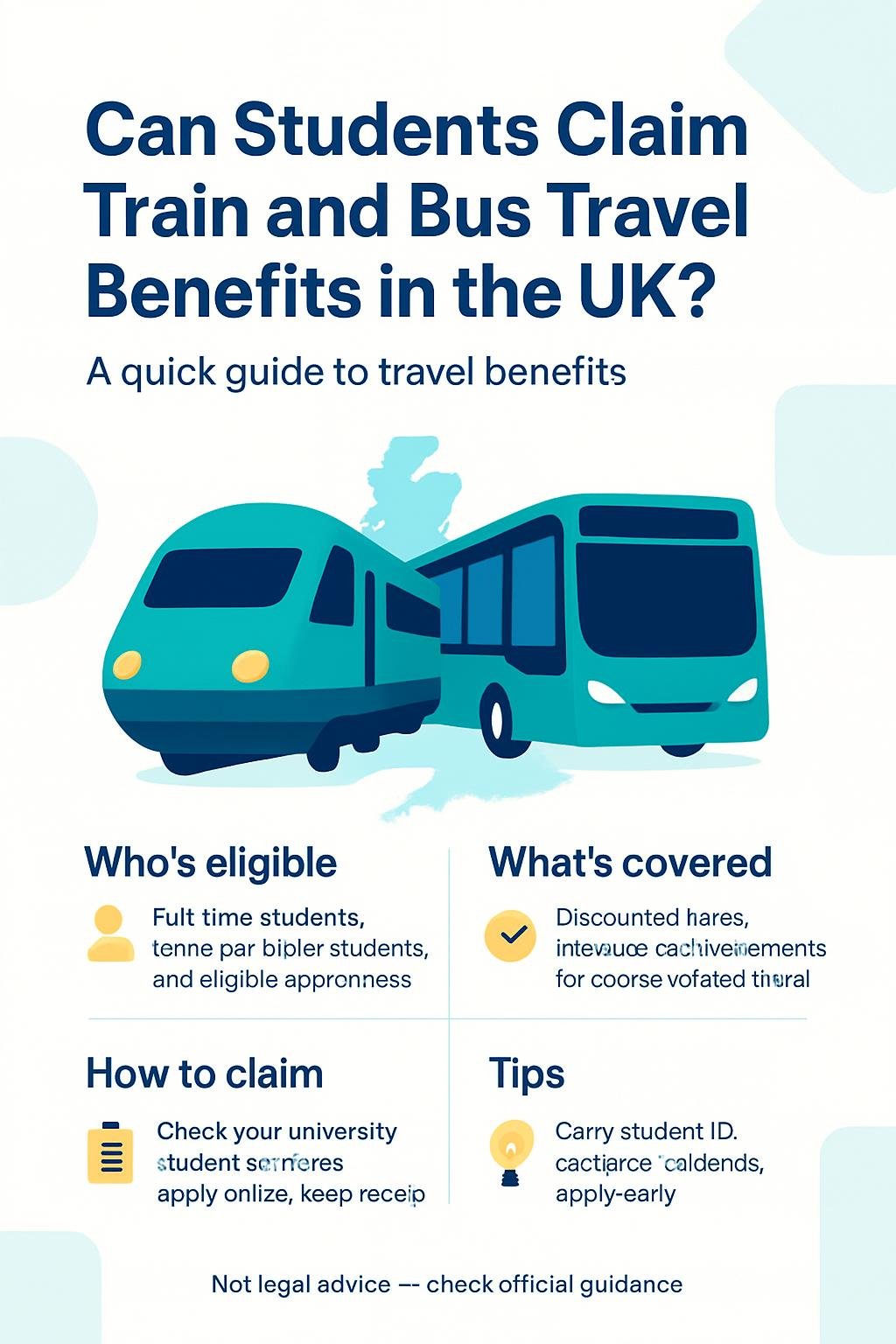
Full-time students are the main group who often get travel discounts. If you study at a college or university on a full-time course, you can usually prove your status with an official student ID, enrolment letter, or a student loan confirmation. Many train operators and local bus companies accept these documents when you buy discounted season tickets, term-time passes, or special student fares. Some universities issue an NUS (now TOTUM) or campus ID that links to discount schemes. For rail travel, a 16–25 Railcard or 26–30 Railcard gives big savings on single and return fares; many full-time students aged up to 30 buy these cards. Also, some universities partner with local transport providers to offer cheaper bus passes for campus routes or the wider city. Check your student services or campus transport office to learn which passes are available, how long they last (term, academic year), and what ID you must show when travelling.
Students with disabilities, care leavers, or those on low income may get extra help. Disabled Students’ Allowances, Personal Independence Payment (if eligible), or local council schemes can offer free or reduced travel. Care leavers often qualify for concession fares until a certain age; contact your local council for details. If you receive Universal Credit or other means-tested benefits, you might be eligible for local travel support or hardship funds that cover transport costs. Always ask your university welfare team or local authority for application steps and supporting documents.
Part-time students usually have fewer automatic entitlements. Many national rail and bus discounts target full-time study, so part-time students should check specific operator rules. Some railcards allow students regardless of full- or part-time status if they can prove age eligibility. For bus travel, look at city-wide concessions or contact the operator; some areas offer discounted community or student passes that accept part-time students under certain conditions (e.g., minimum weekly study hours).
International and visa students should check rules tied to their immigration status. Holding a student visa does not automatically give travel discounts, but official full-time enrolment evidence usually works the same as for domestic students. Be careful: some benefits tied to low income may require UK residency or welfare eligibility, so confirm with student services.
Always keep proof of study and any required ID with you when travelling. If you buy a discounted ticket online, keep the order confirmation on your phone. If challenged, showing valid ID and evidence of enrollment should resolve most issues. For long-term savings, compare season tickets, railcards, and university offers to choose the best option for your travel pattern.
Full-time students and student ID cards
A valid student ID or official proof of enrolment is the key document for many discounts. This document can be:
- A university or college ID card with photo and expiry date.
- An official enrolment letter or electronic confirmation from the university portal.
- A student loan award letter or registration confirmation email for the current academic year.
- A TOTUM card or other recognised student discount card accepted by some operators.
How to use your ID:
- Show it at ticket counters to buy student or term-time tickets.
- Keep it with you while travelling to show to inspectors.
- Upload or link it to transport provider apps when they offer digital student passes.
Practical tips:
- Renew and update your ID every academic year to avoid rejection.
- If your college issues a specific travel pass, register early to get semester or year-long savings.
- If your ID lacks an expiry date, carry supporting proof (enrolment email) showing validity.
- Photocopy or screenshot digital proof in case of phone failure.
Example: Sarah is a full-time undergraduate. She got a campus bus pass through her university for term time and bought a 16–25 Railcard for longer trips home. She shows her student ID plus railcard when buying tickets and saves over £500 a year on travel.
If your student ID is new or you are unsure which passes accept it, contact student services or the local transport operator for a clear list of accepted documents and application steps.
What types of train and bus travel benefits are available?
There are several kinds of travel help students can use. These include national schemes, local passes, and university arrangements. Each type works differently. Some save money on one-off journeys. Others cut the cost of daily travel with season tickets or term passes. Know what you need: short trips, daily commute, or trips home. Compare railcards, bus passes, and campus offers to pick the best saving for your travel pattern. Keep proof of eligibility and check expiry dates so you don’t lose access to discounts.
Railcards and national discounts
Railcards give a set percentage off many train fares across the UK. The common student-friendly railcards are:
- 16–25 Railcard: 1/3 off most rail fares for people aged 16–25 or full-time students under 26.
- 26–30 Railcard: 1/3 off fares for people aged 26–30.
- Two Together Railcard and Family & Friends Railcard: not student-specific but useful for groups or family travel.
Key points:
- Railcards usually require an online application, ID photo, and proof (age or student status for some offers).
- Discount applies to most single and return fares, some season tickets, and advance fares. Check exclusions like some premium services.
- Railcards often last 1 year (or 3 years for some) and pay back their cost in a few uses if you travel home or commute frequently.
- Digital railcards can be stored in apps or on your phone; carry the railcard and a valid ID when travelling.
National bus discounts:
- England has no single national student bus discount scheme. Local councils or bus operators set passes.
- In Wales, Scotland, and Northern Ireland there are stronger national concession schemes for young people and students in some cases (e.g., Young Person’s Travel Card in Wales).
- Many bus companies run student or young person passes for term, monthly, or annual travel within a city or region. These passes can be much cheaper than daily tickets.
How to apply and use:
- Check the official railcard websites and operator pages for eligibility and documents.
- Buy online or at staffed stations. For student-specific offers, use your student ID or enrolment proof.
- For bus passes, visit your local council or bus operator website, or your university transport office. Some accept TOTUM or campus cards.
- Keep digital/physical proof with you. Inspectors may ask for both ticket and ID.
Example: Ali uses a 16–25 Railcard and a city student bus pass. He buys cheaper advance train tickets home and uses the bus pass for daily travel to campus, saving a large part of his travel budget each term.
Tip: Always check terms, age cutoffs, and whether the discount applies during peak times. Some rail promotions or advance fares may be excluded, so compare final prices before buying.

How to apply for train and bus travel benefits
Applying for travel discounts usually means proving you are a student and following a simple application process for each scheme. Start by deciding which benefit you need — a railcard, a local bus pass, or a university transport pass. Visit the official website of the railcard, local council, bus operator, or your university transport office. Read the eligibility rules and required documents carefully. Many schemes have online forms; some need you to apply in person or at a staffed station. Note application deadlines for term passes and allow time for ID verification. Pay any fee (for example, railcards cost a small annual fee) and choose digital or physical delivery of the card or pass. After you get the pass, register it in any required apps and keep digital/printed proof when travelling. If your circumstances change (course status, address, age), update the provider to avoid invalidation. For extra help, contact student services or the local authority transport team.
Documents and application steps
Common documents accepted:
- Official student ID card with photo and expiry date.
- Enrollment letter or confirmation email showing your course, provider, and current academic year.
- Student loan award letter or tuition fee receipt (current year).
- Passport or driving licence for age verification (for railcards).
- Proof of UK address (for some local council passes) such as a bank statement or tenancy agreement.
- Disability evidence (e.g., DSA letter, PIP award) for disability-related travel concessions.
Step-by-step application (general template you can follow):
- Choose the scheme: railcard, local bus pass, or university pass.
- Check the official eligibility page for that scheme.
- Gather documents: student ID, enrolment proof, photo ID, address proof if needed.
- Fill the online form or collect a paper form from the operator or university.
- Upload or attach scanned documents and a passport-style photo if required.
- Pay the fee if the scheme charges one (railcards usually charge).
- Submit the application and note any reference number or confirmation email.
- Receive the pass: download a digital card, print the confirmation, or collect a physical pass.
- Register the pass in any required apps (operator or university app).
- Keep originals and digital backups of documents for inspection while travelling.
Real-life example: Raniya applies for a 16–25 Railcard. She scans her student ID and passport, fills the online form, pays the annual fee, and downloads the digital railcard to her phone. For campus buses, she applies on the university transport portal using her enrolment letter and collects a term pass from the student services desk.
Practical tips:
- Use official pages only; avoid third-party sites that may overcharge.
- Take clear photos/scans of documents to avoid rejection.
- Apply early in the term to ensure you have the pass when term starts.
- Keep soft copies in cloud storage and a screenshot on your phone for inspectors.
Limits and exclusions for student travel benefits
Student travel discounts have clear limits. Not every ticket or route is eligible. Some rail promotions, peak-time services, and premium fares exclude railcard discounts. Local bus passes may only cover specific zones or routes and can exclude night services or long-distance coaches. Many schemes require continuous full-time enrolment; if you drop below required study hours or take a leave of absence, your pass can be revoked. Age limits apply for age-based railcards. Residency or immigration rules can block access to means-tested travel support. Also, some benefits are time-limited (term, academic year) and must be renewed each year. Inspectors can request proof; failure to show valid ID and a matching ticket can lead to fines.
When students cannot claim discounts
Students cannot claim discounts in these common situations:
- Part-time students who do not meet the operator’s definition of student.
- Those without valid, current student ID or enrolment proof.
- Travelling on routes or services that explicitly exclude railcard or pass discounts (check train operator rules).
- Using tickets bought for other people or misrepresenting eligibility—this is misuse and may lead to penalties.
- When age limits exclude you (e.g., over 30 for 26–30 Railcard).
- If you are an international student without required residency status for local council concessions.
- During holiday periods if the pass is a term-time only pass that is not valid outside term dates.
- If your disability or benefit-based concession has expired or you lack up-to-date supporting documentation.
Practical advice:
- Always read the terms for each pass or railcard before buying.
- Carry valid student ID and any extra proof required.
- Renew passes on time and inform providers of status changes.
- If unsure, contact student services or the transport operator to avoid fines.
1 “A short trip or a long journey — the right pass and a little planning make travel cheaper and easier.” 2 “A student ID is more than ID — it’s your ticket to discounts and essential support.” 3 “Buying a railcard is a small investment that delivers savings again and again.” 4 “When your documents are ready, claiming travel concessions becomes simple and straightforward.” 5 “Don’t hesitate to ask for help — student services and your local council can work in your favour.”M Amir
How discounts affect travel costs and budgeting
Travel discounts can cut your travel bills a lot. A railcard can give about 33% off many train fares. A student bus pass can make daily travel much cheaper than buying single tickets. Season tickets or term passes often cost less per journey than paying each time. Choosing the right mix — railcard for long trips home plus a campus or city bus pass for daily commute — gives the biggest savings. Track your usual journeys and compare costs: multiply regular single fares by how often you travel, then compare with the cost of a season ticket plus any railcard fee. Small monthly savings add up fast over a term or year and free up money for essentials like food and books.
Calculating savings and choosing the best option
Step 1 — list your journeys:
- Write down typical trips (daily commute, weekly trips home, occasional weekend travel).
- Note frequency (days per week, weeks per term) and current single/return fare.
Step 2 — estimate current annual cost:
- Multiply each trip fare by its frequency and total across a term/year.
Step 3 — check discount options:
- Railcards: cost (annual fee) and discount (usually 1/3 off eligible fares).
- Student bus passes: term, monthly, or annual prices and covered zones/routes.
- Season or term tickets: price for a block of travel (weekly, monthly, term, annual).
Step 4 — calculate alternative cost:
- Add railcard fee to discounted fares for journeys where railcard applies.
- Add bus pass or season ticket cost for local travel.
- Compare total alternative cost to current annual cost.
Step 5 — choose the best option:
- If railcard fee < savings from discounted long trips, buy the railcard.
- If daily commute cost with single tickets > cost of a term or monthly pass, buy the pass.
- Use a railcard plus a local bus pass if you have both long and short trips.
- For low-frequency travel, buying advance tickets may beat season tickets even with no railcard.
Example calculation:
- Daily campus bus single fare £2 × 5 days × 30 weeks = £300/year.
- Term bus pass £80 per term × 3 terms = £240/year → save £60.
- Monthly train home fare (without railcard) £40 × 9 months = £360.
- With a 16–25 Railcard (annual fee ~£30) and 33% off, train cost ≈ £240 + £30 = £270 → save £90.
Practical tips:
- Use official fare calculators or operator websites to check exact prices.
- Consider peak vs off-peak rules; railcards may not apply to some peak fares.
- Recalculate each year if your travel pattern changes.
- Keep receipts and compare actual spend after a term to confirm savings.
Extra support and concessions for specific groups
Some students get extra travel help because of disability, care leaver status, or low income. These supports often come from national schemes, local councils, universities, or charities. They can cover free or heavily reduced bus travel, help with rail costs, or one‑off travel grants for important journeys like hospital visits or moving into student housing. Eligibility rules vary by area and scheme. Apply early and use your university welfare team or the local authority to find the right scheme and required documents.
For students who want a full overview of travel discounts and other support, read our complete student benefits guide: https://ukbenefitsguide.online/benefits-for-students-in-the-uk-complete-guide/. That page covers student entitlements, bursaries, council concessions, and practical advice on saving money and applying for the right passes.
Disabled students, care leavers, and low‑income support
Disabled students
- What’s available: local concessionary bus passes, rail discounts or exemptions, travel allowances from Disabled Students’ Allowances (DSAs) to pay for taxis or specialist transport where needed. Some train operators provide assistance at stations and may waive some fares in special cases.
- Eligibility documents: DSA letter, PIP award notice, GP or specialist letter, or university disability services confirmation.
- How to apply: contact your university disability service for DSAs and practical help; check local council websites for concessionary bus pass application processes; contact rail operator assistance teams for station help and possible fare allowances.
- Example: A student with mobility issues gets a local concession bus pass and DSA-funded taxi vouchers for essential medical trips.
Care leavers
- What’s available: many councils offer travel concessions or discounted travel until a set age for care leavers. Universities sometimes provide additional support like free term bus passes or travel grants.
Eligibility documents: a letter from the leaving care team, a personal adviser contact, or official care leaver documentation from social services.
- How to apply: contact your local authority’s leaving care team and student services at your university. They can advise on council passes and any university bursaries that include travel help.
- Example: A care leaver receives a discounted annual bus pass from the council and a one‑off travel grant from the university to cover moving costs.
Low‑income students
- What’s available: hardship funds from universities, discounted local student bus passes, and occasional council schemes for those on means-tested benefits. Some charities offer travel vouchers for students in crisis.
- Eligibility documents: evidence of benefits (Universal Credit, income support), a university hardship application, or bank statements showing low income.
- How to apply: apply to the university hardship or welfare fund; check local council concession pages; speak to a student adviser who can submit emergency travel requests on your behalf.
- Example: A student on Universal Credit gets a small travel grant from the university hardship fund to cover essential travel during exam period.
Practical tips for these groups
- Always ask student welfare or disability services for help preparing applications.
- Keep up‑to‑date medical or benefit documents; some schemes need recent proof.
- Combine support: use concession passes plus university hardship funds where allowed.
- Keep records of applications and correspondence in case you need to appeal.
For self-employed readers needing housing help, see our detailed guide on claiming Housing Benefit as a self-employed person in the UK: https://ukbenefitsguide.online/self-employed-housing-benefit-uk/. It explains eligibility rules, how income is assessed for self‑employed applicants, required documents, and step‑by‑step tips for applying and reporting income changes.
Frequently Asked Questions (FAQs)
Full-time students aged 16–25 or under 26 for certain student offers; age-based railcards (26–30) for relevant ages. Proof of age or enrolment is required.
Sometimes. Part-time students may get age-based railcards but often miss full student pass schemes; check each operator’s rules.
Commonly: student ID, enrolment letter or loan award, passport or driving licence for age, proof of UK address for some local passes, and disability evidence if applicable.
It depends. Term-time passes may not be valid during holidays; annual passes usually cover the full year. Check pass terms.
Some peak fares are excluded. Always check the railcard terms for peak-time restrictions and fare exclusions.
Conclusion
Students can often get meaningful savings on train and bus travel in the UK, but eligibility and value depend on age, course type, and personal circumstances. Full-time students usually have the best access to student passes, railcards, and university or local offers. Disabled students, care leavers, and low‑income students may get extra concessions or grants. Always check the specific scheme rules, carry valid proof of enrolment and ID, compare costs (railcard + passes vs single tickets), and contact student services or your local council for guidance. With the right documents and a little planning, students can cut travel costs significantly and avoid fines or rejected claims.






- Be Respectful
- Stay Relevant
- Stay Positive
- True Feedback
- Encourage Discussion
- Avoid Spamming
- No Fake News
- Don't Copy-Paste
- No Personal Attacks
- Be Respectful
- Stay Relevant
- Stay Positive
- True Feedback
- Encourage Discussion
- Avoid Spamming
- No Fake News
- Don't Copy-Paste
- No Personal Attacks
