Self-Employed Benefits in the UK – Complete Guide
Published: 17 Jan 2026
Introduction
Are you self-employed in the UK?
Do you run your own business?
Do you work as a freelancer, driver, seller, or service provider?
Self-employed work gives freedom.
You choose your hours.
You choose your clients.
You control your income.
But self-employed work also brings risk.
Income changes every month.
Some months are strong.
Some months are weak.
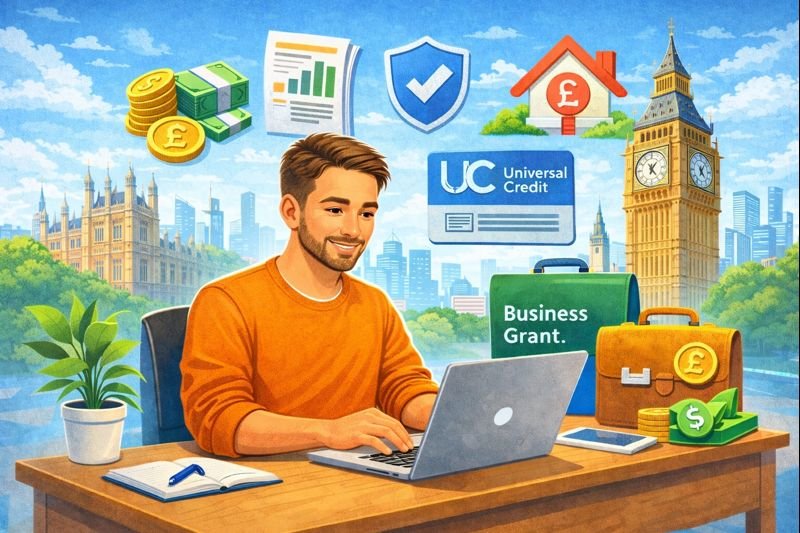
Bills do not stop.
Rent does not stop.
Food does not stop.
That is why benefits matter.
Benefits protect your life.
Benefits support your home.
Benefits help your business survive.
This guide explains self-employed benefits in the UK.
This guide uses simple words.
This guide gives real examples.
This guide gives clear steps.
This guide helps you understand:
- What self-employed benefits are
- Who can get them
- How to apply
- How to save more money
Let us begin.
What Does Self-Employed Mean?
A self-employed person works for himself.
A self-employed person runs a business.
A self-employed person earns from customers.
You are self-employed if:
- You run a shop
- You drive a taxi
- You sell online
- You work as a freelancer
- You run a small service
- You run a food stall
- You offer repair services
You do not work for a company.
You do not get a monthly salary.
You earn from your work.
You manage your time.
You manage your money.
You manage your business.
What Are Self-Employed Benefits in the UK?
Self-employed benefits are support programs.
These programs help when income is low.
These programs help when work stops.
These programs help with rent and food.
These programs help with health and family.
The UK government provides these benefits.
Local councils also provide support.
Self-employed benefits include:
- Universal Credit
- Housing support
- Tax benefits
- Business grants
- Maternity benefits
- Health support
These benefits protect your life.
These benefits protect your business.
These benefits protect your future.
Why Are Self-Employed Benefits Important?
Self-employed income changes every month.
Bills stay the same every month.
Rent stays the same.
Food costs stay the same.
Benefits reduce stress.
Benefits give safety.
Benefits give support.
Benefits help you:
- Pay rent
- Buy food
- Pay bills
- Run your business
- Care for your family
Real-Life Example
Imran runs a small food stall.
Some days are busy.
Some days are slow.
One month his income drops.
Rain affects sales.
Customers stay home.
Imran cannot pay full rent.
Imran feels worried.
Imran applies for Universal Credit.
He reports his income.
He gets monthly support.
Imran pays his bills.
Imran keeps his business running.
Imran feels safe.
Types of Self-Employed Benefits in the UK
The UK offers many support programs.
Each program helps in a different way.
Let us explore them one by one.
1. Universal Credit for Self-Employed
Universal Credit is a monthly payment.
It helps with living costs.
It helps when income is low.
It helps when work stops.
Universal Credit covers:
- Rent
- Food
- Electricity
- Gas
- Water
- Daily needs
Who Can Apply for Universal Credit?
You can apply if:
- You live in the UK
- You are self-employed
- Your income is low
- Your savings are below limit
How Universal Credit Works
You create an online account.
You apply online.
You report your income every month.
The system checks your earnings.
Your payment changes each month.
Low income gives more support.
High income gives less support.
Minimum Income Floor
The system checks your business income.
It compares income with minimum wage.
It uses a standard amount.
If your income is below this level,
The system still uses the standard amount.
This rule applies after one year of business.
Real Example
Ali is a taxi driver.
Winter season is slow.
Few people travel.
Ali earns less money.
Ali applies for Universal Credit.
Ali reports his income.
Ali gets monthly support.
Ali pays rent and bills.
2. Housing Support for Self-Employed
Rent is expensive in the UK.
House bills are high.
Living costs increase every year.
Universal Credit includes housing support.
This part helps pay rent.
Who Can Get Housing Support?
You can get support if:
- You rent a home
- Your income is low
- You live in the UK
- You meet housing rules
How Housing Support Works
The system checks your rent.
The system checks your income.
The system pays support monthly.
Real Example
Zara runs a beauty salon.
Her income drops in winter.
Few clients visit.
She struggles with rent.
She applies for housing support.
She gets monthly help.
She keeps her home.
She keeps her business.
3. Tax Benefits for Self-Employed
The UK gives tax benefits.
These benefits reduce your tax bill.
These benefits save your money.
Personal Allowance
You earn a tax-free amount.
You pay no tax on this part.
This amount changes every year.
Business Expenses
You can claim business costs.
This reduces your tax.
You can claim:
- Phone bills
- Internet bills
- Travel costs
- Fuel costs
- Office rent
- Tools and equipment
- Marketing costs
Capital Allowances
You can claim big items.
You can claim machines.
You can claim vehicles.
This reduces your tax.
Real Example
Hassan is a graphic designer.
He buys a laptop.
He buys design software.
He claims these costs.
He pays less tax.
He saves money.
1“Self-employment gives freedom, and benefits give security.” 2“A strong business needs strong support.” 3“Success grows when support stands with you.” 4“Self-employed work builds dreams, and benefits protect them.” 5“Smart workers use every support they deserve.”M Amir
4. Business Grants and Support
Grants are free money.
You do not repay grants.
You use grants to grow business.
The UK offers many grants.
Local councils offer grants.
Business groups offer grants.
Types of Business Support
- Startup grants
- Growth grants
- Digital grants
- Green business grants
- Local business funds
How Grants Help
Grants help buy tools.
Grants help build websites.
Grants help run ads.
Grants help train staff.
Real Example
Aisha opens a bakery.
She applies for a startup grant.
She gets £2,000 support.
She buys baking tools.
She buys a fridge.
She grows her business.
5. Maternity Benefits for Self-Employed
Self-employed women get maternity support.
The government supports new mothers.
Maternity Allowance
This is a weekly payment.
It supports new mothers.
It supports during pregnancy.
It supports after birth.
Who Can Apply for Maternity Allowance?
You can apply if:
- You are self-employed
- You are pregnant
- You worked before birth
How Long Is Maternity Allowance?
It pays for many weeks.
It supports early motherhood.
Real Example
Nida runs a tailoring shop.
She becomes pregnant.
She applies for Maternity Allowance.
She gets weekly payments.
She rests and recovers.
She cares for her baby.
6. Health Support for Self-Employed
Health is important.
Health protects your work.
Health protects your life.
The NHS supports everyone.
Self-employed people get:
- Free GP visits
- Free hospital care
- Mental health support
- Emergency care
Sick Pay Rules
Self-employed people do not get sick pay.
But they can get Universal Credit.
They can get council support.
Real Example
Usman gets sick.
He cannot work.
He cannot earn.
He applies for Universal Credit.
He gets support.
He recovers in peace.
Who Can Apply for Self-Employed Benefits?
Many people can apply.
You can apply if:
- You are self-employed
- You live in the UK
- You registered with HMRC
- You report income
How to Register as Self-Employed
Registration is important.
Benefits need proof.
Step-by-Step Registration Guide
- Visit HMRC website
- Create government account
- Register as self-employed
- Get Unique Tax Number
- Start income records
How to Apply for Self-Employed Benefits
Applying is simple.
You only need a few steps.
Step-by-Step Application Guide
- Register with HMRC
- Track your income
- Create government account
- Apply online
- Upload documents
- Report monthly income
Documents You Need
- National Insurance number
- ID proof
- Address proof
- Bank details
- Income records
Real Example
Bilal registers with HMRC.
He applies for Universal Credit.
He uploads income proof.
He gets approval.
He receives payments.
He manages his business.
Common Mistakes Self-Employed People Make
Many people lose support.
They make small mistakes.
Common Errors
- Not registering with HMRC
- Missing income reports
- Giving wrong details
- Missing deadlines
- Ignoring letters
Real Example
Omar forgets income report.
His payment stops.
He fixes it later.
Tips to Get More Support
Follow simple habits.
Smart Tips
- Keep income records
- Save receipts
- Use business apps
- Track expenses
- Check council support
- Ask for advice
Best Apps for Self-Employed People
Apps help manage money.
Useful Apps
- FreeAgent
- QuickBooks
- Xero
- HMRC app
Extra Council Support
Local councils help residents.
They offer:
- Emergency grants
- Food support
- Rent help
- Business advice
Budget Plan for Self-Employed
A budget controls money.
Sample Monthly Budget
- Rent: £600
- Food: £200
- Bills: £150
- Travel: £100
- Business: £150
Total: £1,200
Use benefits to balance this.
Support During Low Income
Low income happens.
Support is available.
Help Options
- Universal Credit
- Council grants
- Food banks
- Business support
Support for New Businesses
New businesses need help.
Startup Support
- Startup grants
- Free training
- Business mentors
- Local funds
Benefits for Part-Time Self-Employed
Part-time workers get support.
They can get:
- Universal Credit
- Tax benefits
- Council support
Benefits for Online Sellers
Online sellers are self-employed.
They can get:
- Tax benefits
- Business grants
- Universal Credit
Benefits for Taxi Drivers
Taxi drivers need support.
They can get:
- Universal Credit
- Fuel support
- Business grants
Benefits for Shop Owners
Shop owners face risks.
They can get:
- Business grants
- Tax benefits
- Council support
Benefits for Freelancers
Freelancers work online.
They can get:
- Universal Credit
- Tax benefits
- Business grants
FAQs – Self-Employed Benefits in the UK
Q1: Can self-employed people get Universal Credit?
Yes. If income is low.
Q2: Do self-employed people get sick pay?
No. But they get other support.
Q3: Can new businesses get benefits?
Yes. Many grants support startups.
Q4: Do self-employed people get housing support?
Yes. Through Universal Credit.
Q5: Do self-employed people pay tax?
Yes. But they get tax benefits.
Yes. Self-employed people can get Universal Credit if their income is low.
Final Checklist
Use this list.
- Register with HMRC
- Track income
- Apply for Universal Credit
- Claim expenses
- Check council grants
- Save receipts
Conclusion
Self-employed work gives freedom.
Self-employed work also brings risk.
The UK offers strong support.
Benefits protect your income.
Benefits protect your home.
Benefits protect your future.
Use every support program.
Apply early.
Stay organised.
Final Tip
Check your benefits every year.
Rules change.
Support grows.
Your business matters.
Your life matters.
Use the help available.






- Be Respectful
- Stay Relevant
- Stay Positive
- True Feedback
- Encourage Discussion
- Avoid Spamming
- No Fake News
- Don't Copy-Paste
- No Personal Attacks
- Be Respectful
- Stay Relevant
- Stay Positive
- True Feedback
- Encourage Discussion
- Avoid Spamming
- No Fake News
- Don't Copy-Paste
- No Personal Attacks
